
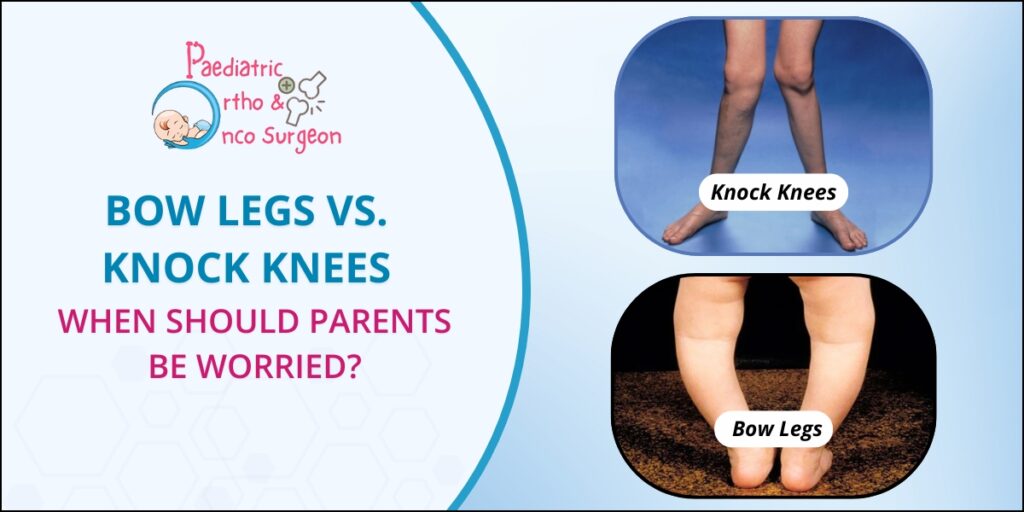
Bow Legs vs. Knock Knees: When should parents be worried?
As a parent, it’s natural to closely observe every aspect of your child’s development, including how they walk and stand. Noticing that your toddler’s legs aren’t perfectly straight can be concerning. However, both bow legs and knock knees are often a normal part of childhood growth. Understanding the difference between typical development and a potential problem is key to knowing when to relax and when to seek professional advice. What are Bow Legs (Genu Varum)? Bow legs, medically known as Genu Varum, is when a child stands with their feet together but there’s a distinct gap between their knees. Their legs curve outward, resembling the shape of a bow. It’s extremely common in infants and toddlers, often noticeable when they start walking. Typical Age Range: Birth to around 2-3 years old. What are Knock Knees (Genu Valgum)? Knock knees, or Genu Valgum, are the opposite. When a child stands with their knees together, their ankles remain apart. The legs curve inward, so the knees “knock” together while walking. Typical Age Range: Often appears around age 3-4 and can persist until age 7-8. The Normal Developmental Journey Your child’s legs undergo a predictable, natural alignment process: Infancy: Most babies are born with bow legs due to their folded position in the womb. Toddler Years (1-3): Bowing may become more pronounced as they begin to walk, then gradually straightens. Preschool (3-6): Legs often transition into mild knock knees. Late Childhood (7+): Legs typically find their final, nearly straight alignment. This process is a normal part of skeletal maturation and usually requires no intervention. Red Flags: When to Consult a Pediatric Orthopedic Surgeon While most cases resolve on their own, certain signs warrant a professional evaluation. Consult a specialist if you notice: Asymmetry: One leg bows or knocks significantly more than the other. Severe Angulation: The curve seems extreme or is getting worse over time, not better. Pain or Limping: Your child complains of knee, hip, or leg pain, or develops an abnormal gait. Timing Issues: Bowing persists after age 3, or knock knees persist or worsen after age 7-8. Other Symptoms: Short stature, delayed motor skills, or other physical abnormalities. Early diagnosis of underlying conditions (like Blount’s disease, rickets, or skeletal dysplasias) is crucial for effective treatment, which may include bracing, physical therapy, or, in rare cases, surgery. If you have concerns about your child’s leg alignment, seeking expert advice consult Dr. Vinod Dubey is a renowned Pediatric Orthopedic surgeon in Mumbai and Thane Region, specializing in the diagnosis and management of childhood bone and joint conditions. With extensive expertise in children’s leg alignment issues, growth-related orthopedic problems, and developmental dysplasia. Dr. Vinod Dubey is widely recognized as a leading child bone specialist in Thane for treating complex conditions like clubfoot, limb length discrepancies, and pediatric fractures, helping children achieve healthy, active development. Frequently Asked Questions 1. Do babies grow out of bow legs? Yes, most children outgrow physiological bow legs naturally by the age of 3 as they start walking and their leg muscles develop. 2. Can knock knees be corrected? In the vast majority of children, knock knees correct themselves by late childhood (around age 7-8). Only severe, progressive, or asymmetric cases require medical intervention. 3. What causes knock knees in children? Most are part of normal development. Less commonly, they can be caused by underlying conditions like obesity, injury, infection, or metabolic bone diseases like rickets. 4. Is it normal for a 2-year-old to have knock knees? Not typically. Knock knees usually develop after age 2-3. Bowing is more common at age 2. If your 2-year-old has noticeable knock knees, mention it to your pediatrician. 5. How do you test for knock knees? A simple home observation: have your child stand with knees touching. If the ankles are more than 3-4 inches apart (or 8-10 cm) for a young child, it’s a good idea to get a professional assessment.
Bow Legs vs. Knock Knees: When should parents be worried? Read More »